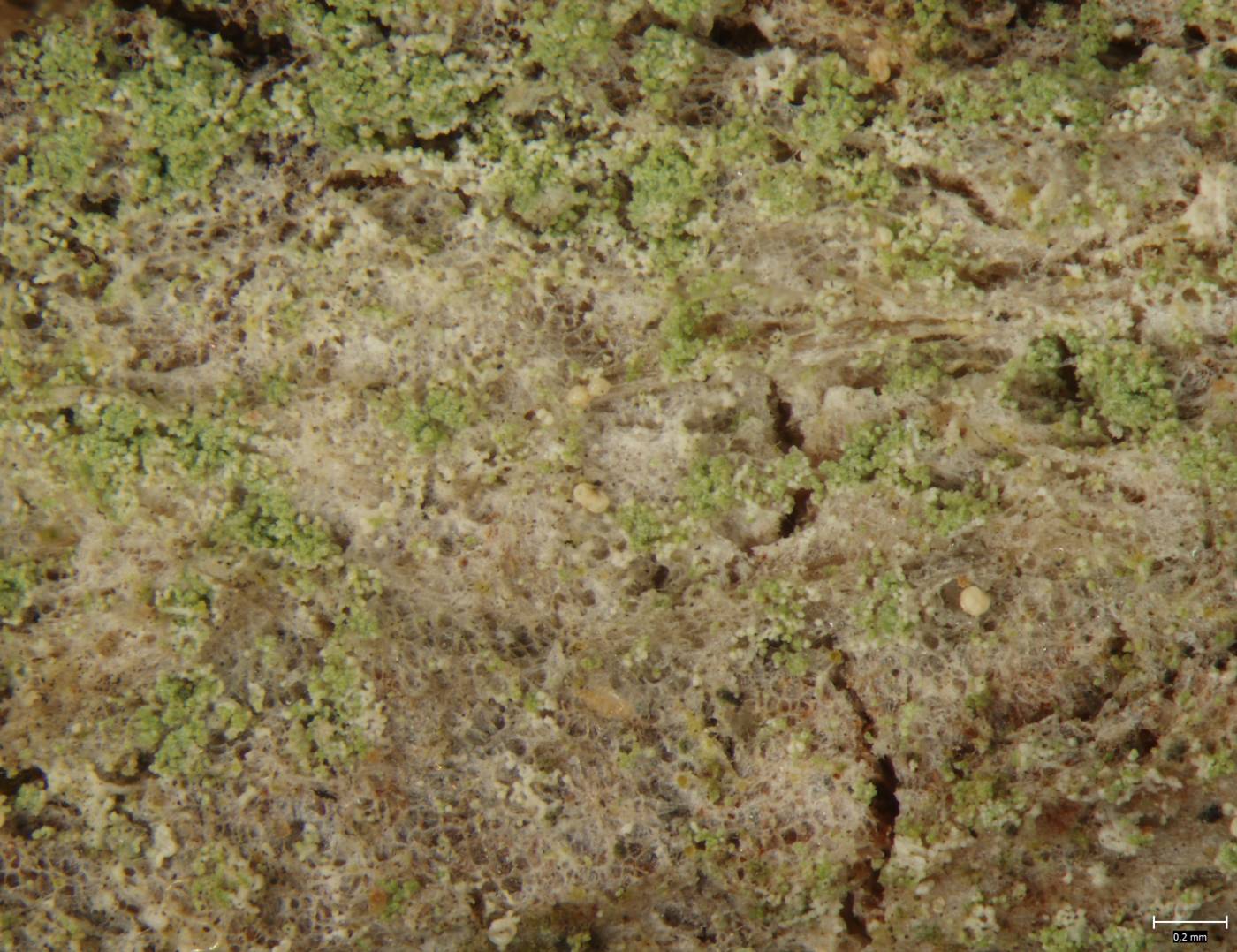
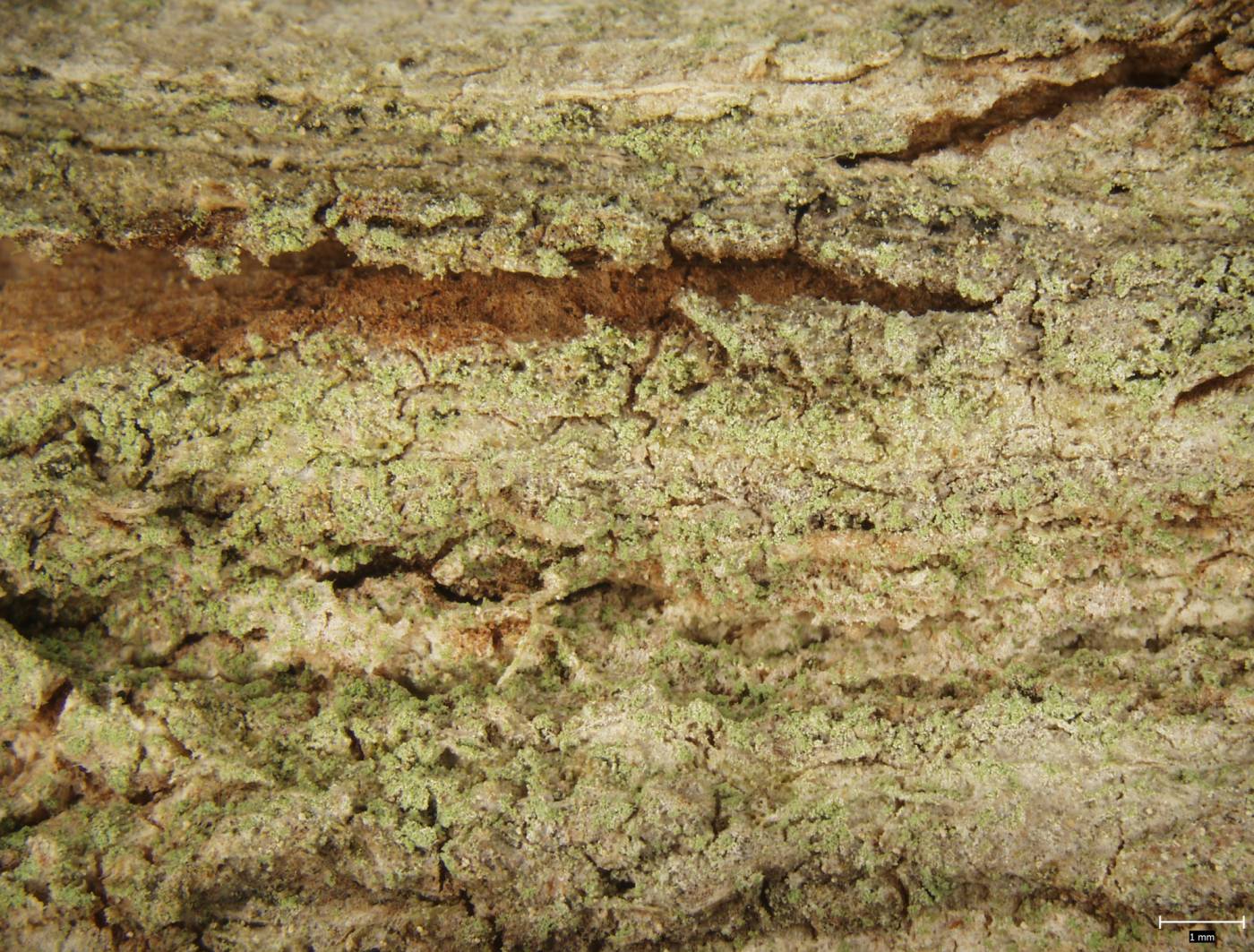
This Bacidina usually forms extensive patches of yellowish to pea-green soralia, which are slightly convex. The soralia are mostly round or elongated, long-delimited, and only exceptionally merging into a continuous sorediate crust. The lichen can be mistaken for algal films or other sorediate, sterile lichens forming monotonous patches. Reliable identification requires TLC or molecular data. The diagnostic compound is an unknown depside or depsidone, migrating slightly above atranorin in all three commonly used solvent systems (A, B′, C). Terpenoids may also be present (often only in trace amounts), though contamination from the substrate or solvent cannot be entirely excluded.
Bacidina paradoxa usually grows on moderately acidic, more nutrient-rich bark of deciduous trees, typically on elder. It seems to avoid strongly nitrophilous communities dominated by Physciaceae and Teloschistaceae. A saxicolous occurrence on a gneiss stone has also been reported (Ghlimová et al. 2025). This species is almost certainly overlooked, and since its description in 2023 it has already been discovered at additional localities in the Czech Republic. It is also reported from Austria (Vondrák et al. 2023).
Literature: Ghlimová H. et al. (2025): Lišejníky zaznamenané během 36. bryologicko-lichenologických dní na Radnicku. – Bryonora 75: 83–101. Vondrák J. et al. (2023): Martin7: a reference database of DNA barcodes for European epiphytic lichens and its taxonomic implications. – Preslia 95: 311–345.
taxonomic classification:Ascomycota → Lecanoromycetes → Lecanorales → Ramalinaceae → Bacidina
Occurrence in the Czech Republic
All records: 16, confirmed 12. One click on a selected square displays particular record(s), including their source(s).