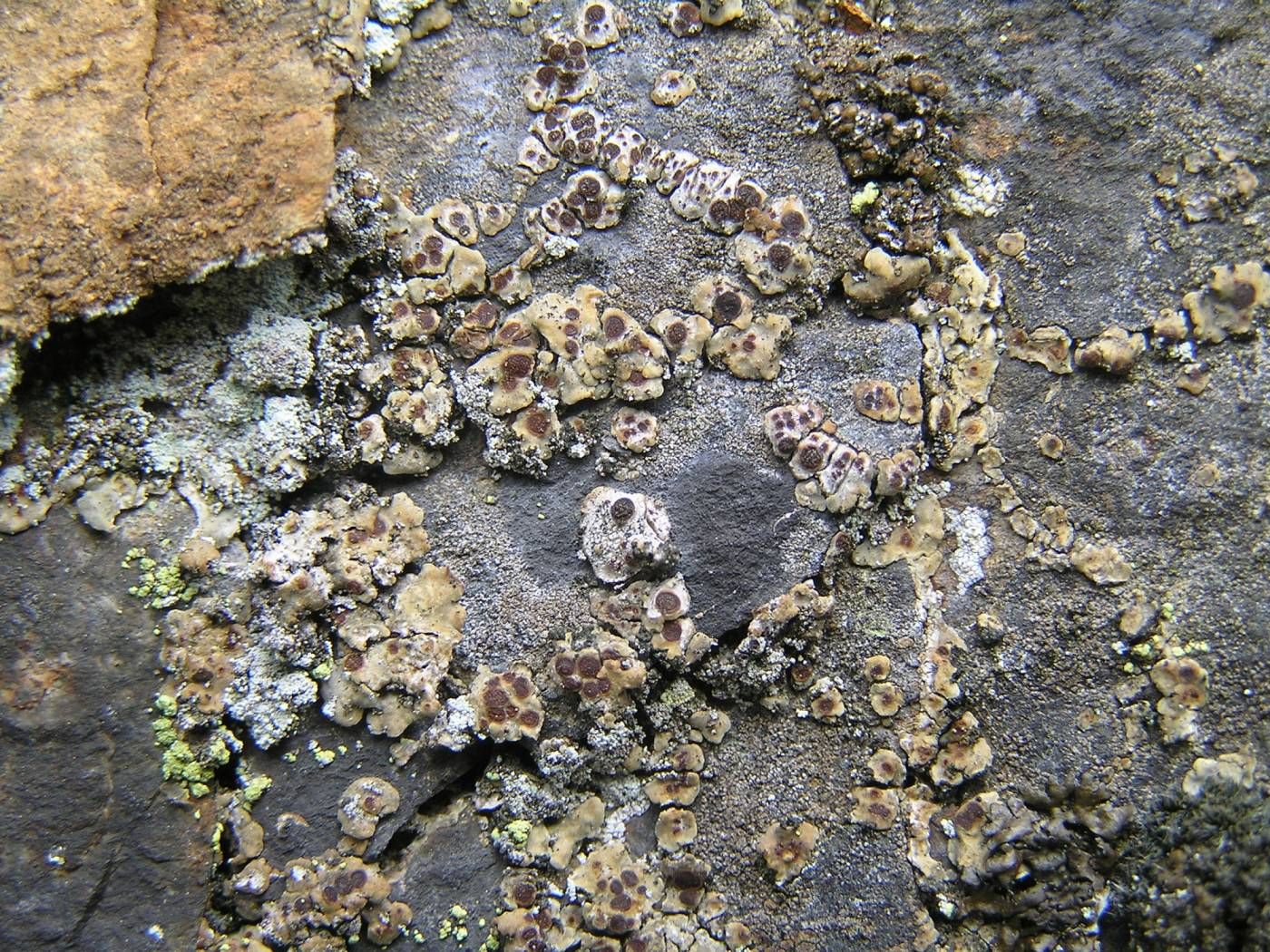
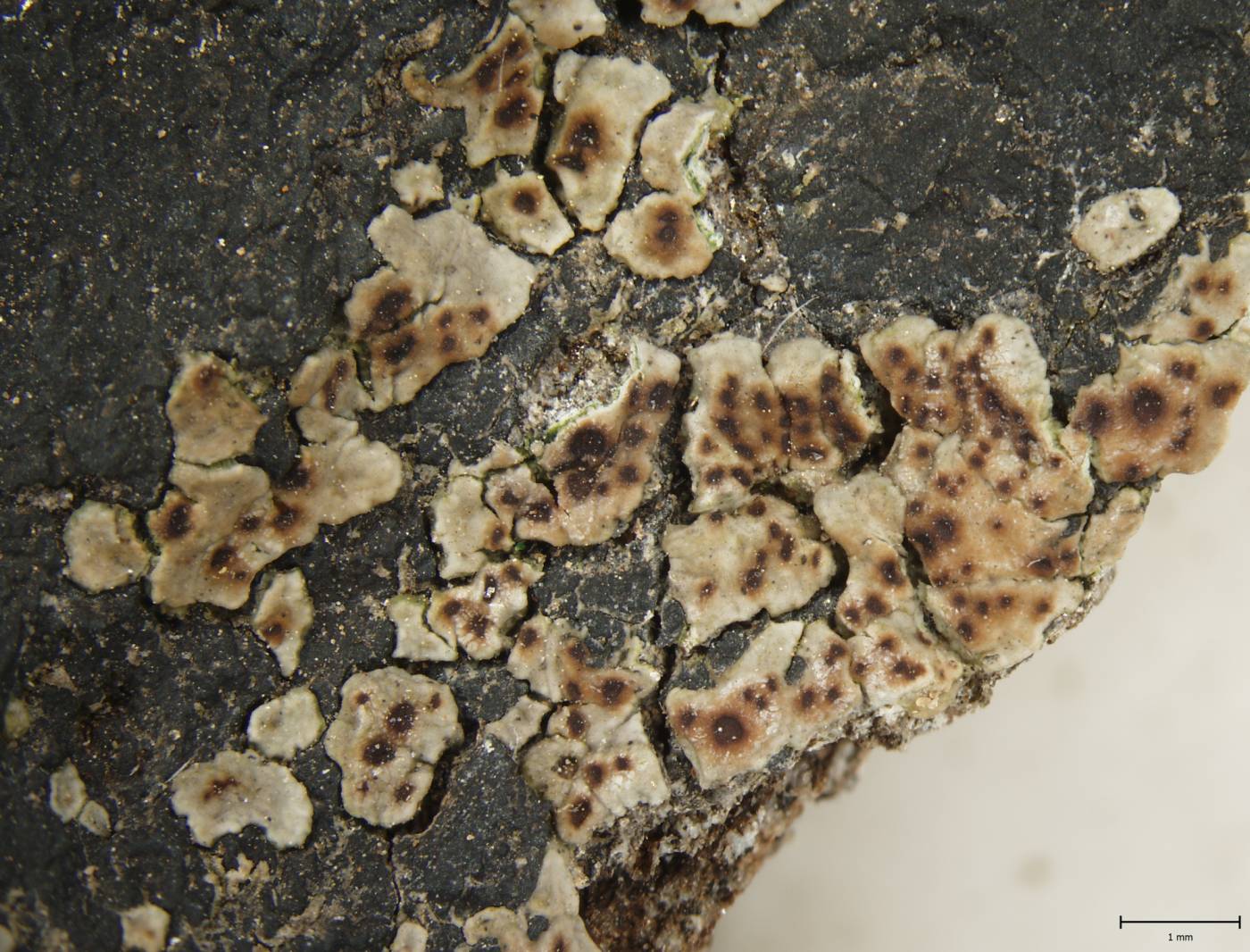
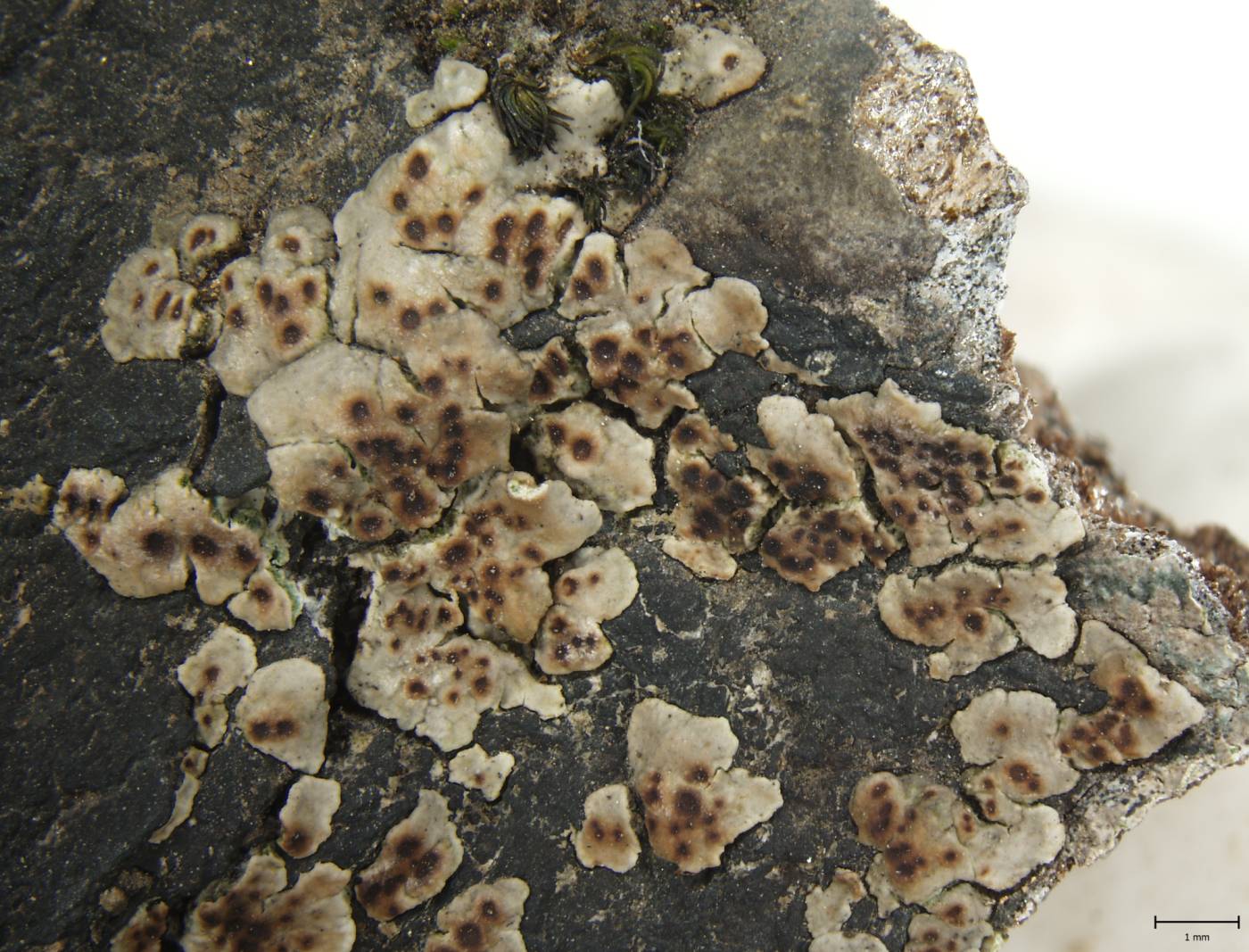
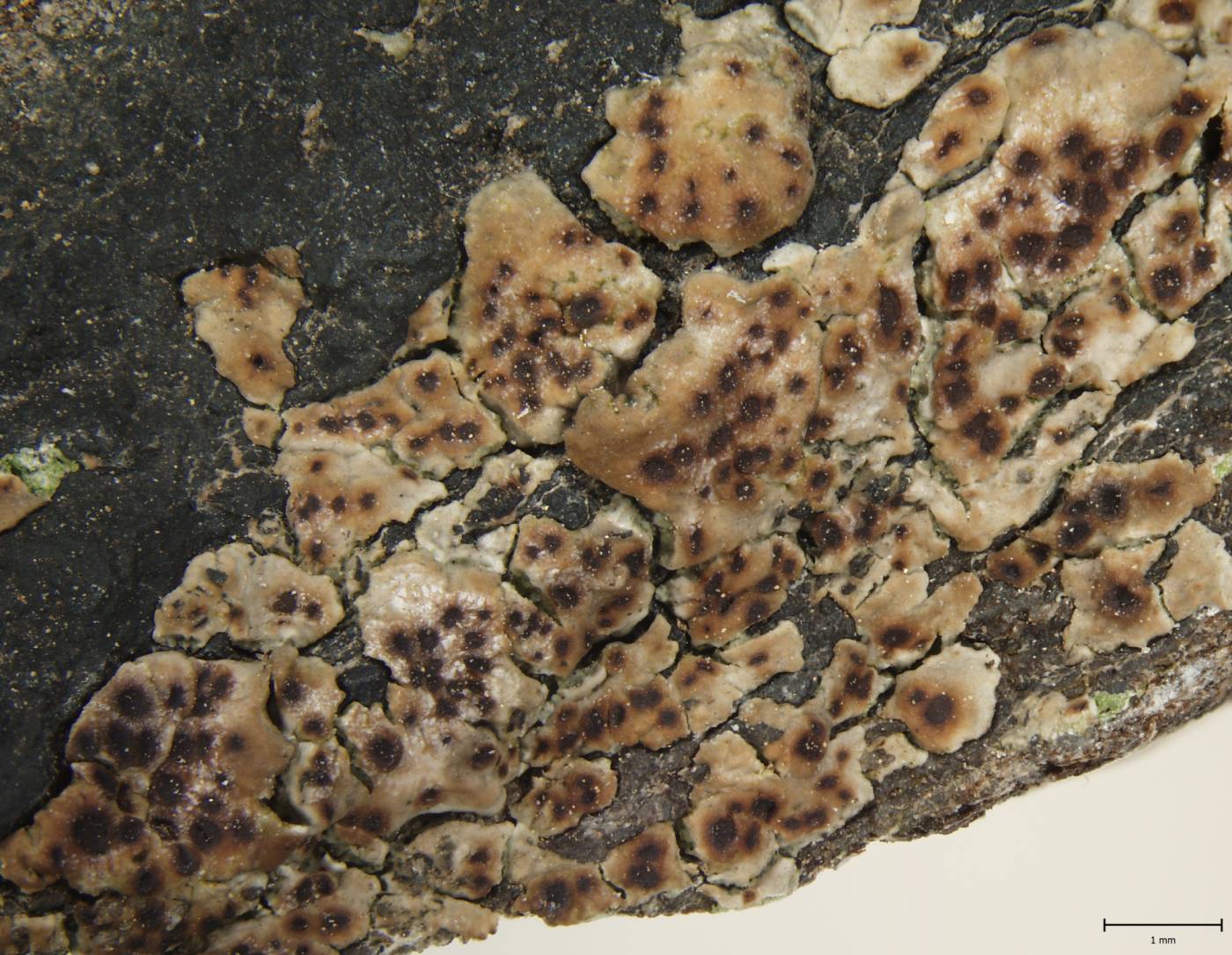
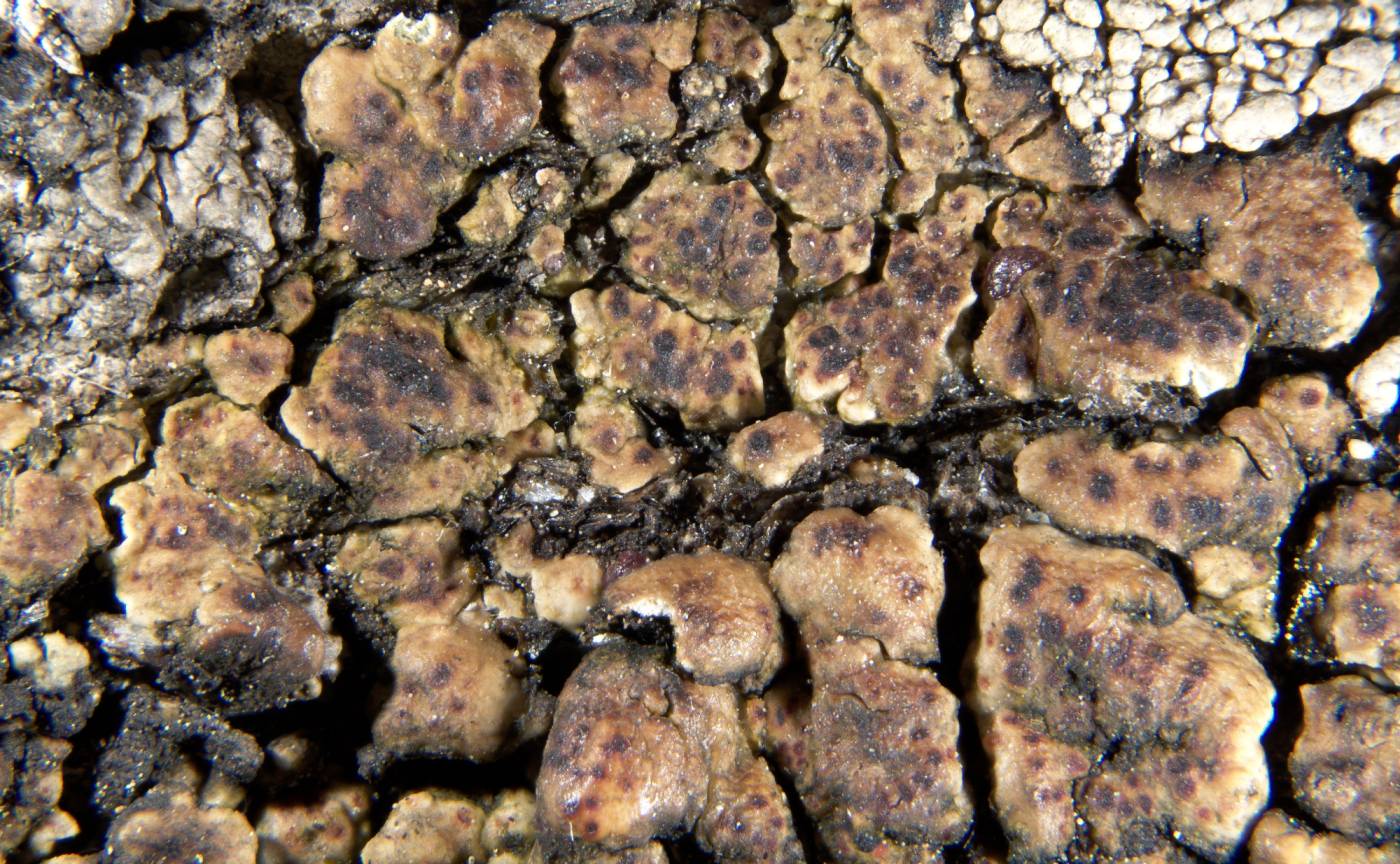
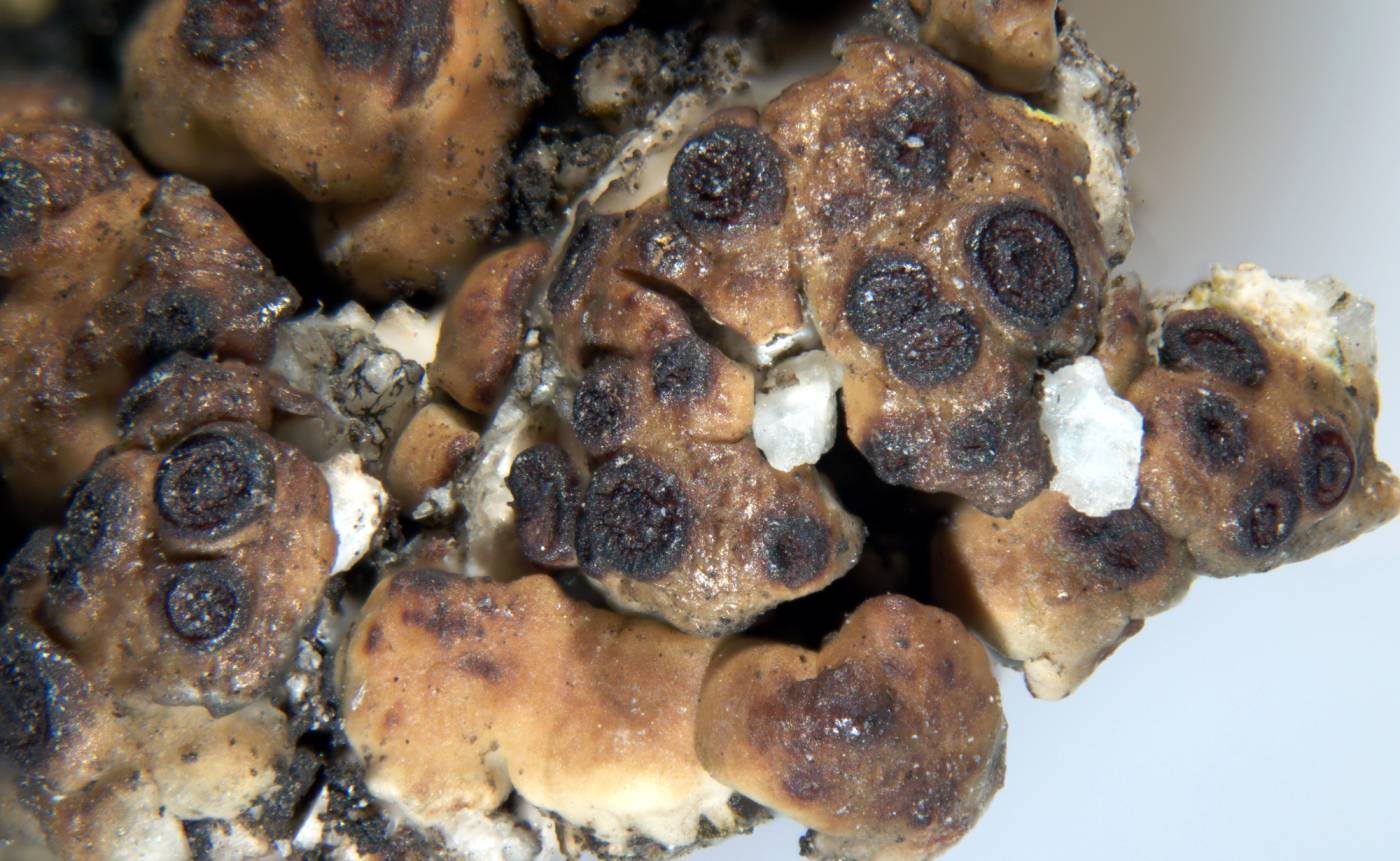
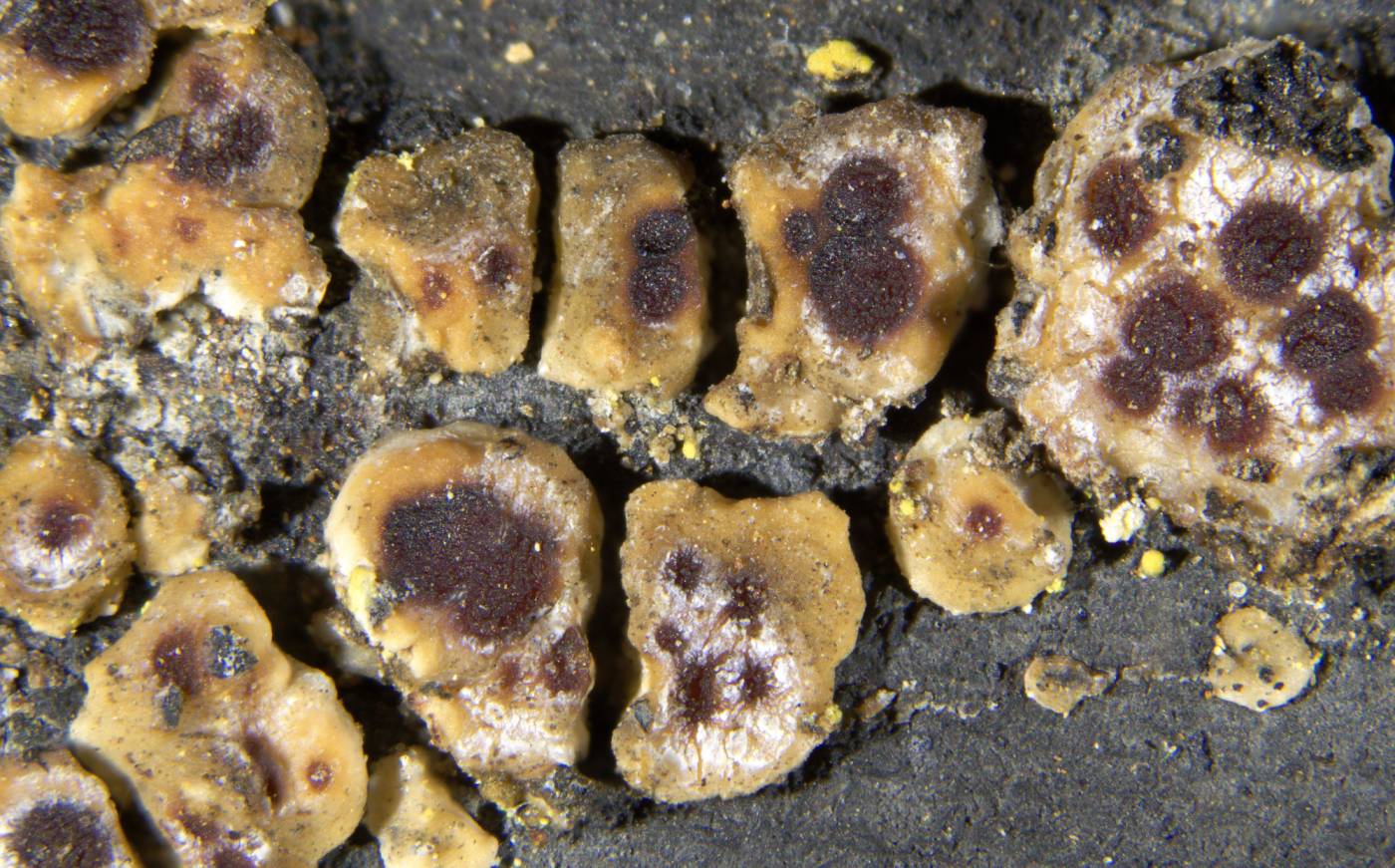
The thallus of M. hilitzeri consists of areoles (1.0–)1.5–2.0(–4.0) mm wide with up to ten apothecia in the process of replicating by division. The upper surface is pale brown, sometimes almost orange. Apothecia are initially immersed and expand to 0.5 mm in width. The parathecium is indistinct, 15–30 µm wide, eventually forming a ring around the immersed apothecia, which may become elevated, with a margin concolorous with the thallus to black. The hymenium is 130–170 µm high. Paraphyses are 1 µm wide, with unexpanded apices enclosed in a narrow gel cap up to 2 µm wide. The hymenial gel is IKI+ light blue to red or red, hemiamyloid. Ascospores are 2–3(–4) × 1–3 µm. Secondary metabolites are absent.
Myriospora hilitzeri was described from the Czech Republic in 2026, where it is locally frequent, for example in the Hrubý Jeseník Mountains. The type locality is Mt Červená hora. It has also been reported from Germany and Italy. The species occurs on non-calcareous rocks, including iron-rich substrates, and is often found on vertical or overhanging rock surfaces.
Because of its large, undivided areoles containing numerous immersed apothecia, it has sometimes been identified as M. myochroa lacking norstictic acid. Specimens with a pale brown to almost orange thallus and small immersed apothecia have also been misidentified as M. tangerina. Specimens with elevated apothecia have occasionally been misidentified as young M. scabrida. Another very similar species is M. macrophylla, which differs in having larger squamules (4–10 mm vs. 1.5–2 mm) with a greater number of apothecia (10–20 vs. ≤10).
Literature: Knudsen, K., Pušová T., Kocourková J. & Kondrysová E. (2026): Two new species of Myriospora (Lecanoromycetes, Acarosporomycetidae, Acarosporales, Acarosporaceae) from Europe, one last observed in 1925. – MycoKeys 139: 73–87.
taxonomic classification:Ascomycota → Lecanoromycetes → Acarosporales → Acarosporaceae → Myriospora
Occurrence in the Czech Republic
All records: 5, confirmed 4. One click on a selected square displays particular record(s), including their source(s).