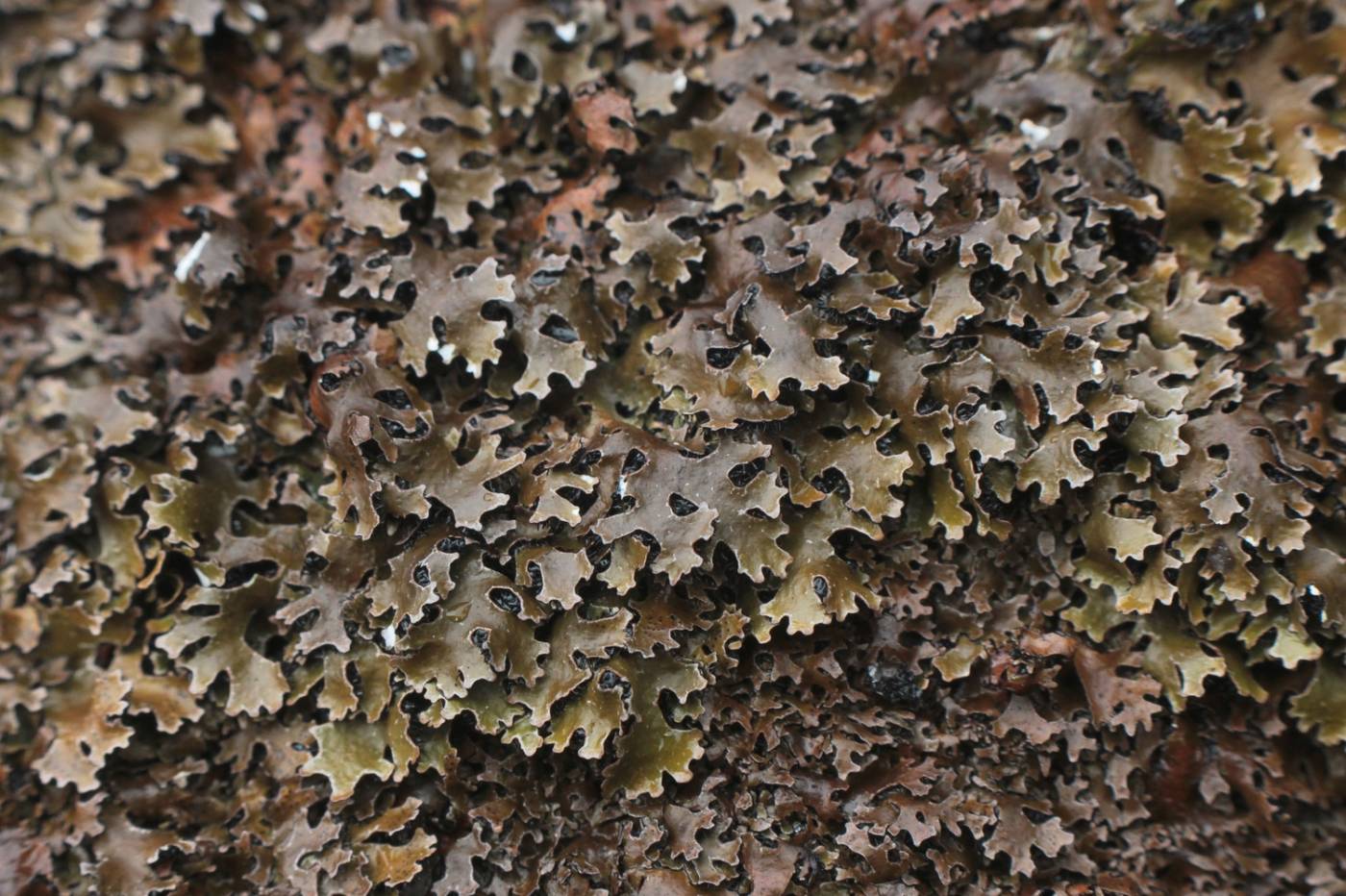
In the Central European context, this group comprises three similar species: Parmelia discordans, P. omphalodes s. str. and P. pinnatifida. They are predominantly saxicolous lichens growing on siliceous rocks and lacking isidia and soredia. The individual species are distinguished mainly by the shape and colour of their lobes, the distribution of pseudocyphellae and the chemical composition of the medulla. However, their morphological variation overlaps considerably, and the identification of small or incomplete specimens may be unreliable. In such cases, the designation P. omphalodes agg. should be used. Furthermore, the taxonomic delimitation of P. discordans from P. omphalodes has not yet been fully resolved.
In the past, members of the group were usually reported from the Czech Republic under the name P. omphalodes. However, a revision of herbarium material showed that P. pinnatifida is the commonest member of the group in the country, whereas the occurrence of P. omphalodes s. str. has not been reliably documented.
Literature: Malíček J. & Ludvíková J. (2026): Does Parmelia omphalodes s. str. occur in the Czech Republic? – Bryonora 77: 1–13. /// Ossowska E., Guzow-Krzemińska B., Kolanowska M., Szczepańska K. & Kukwa M. (2019): Morphology and secondary chemistry in species recognition of Parmelia omphalodes group – evidence from molecular data with notes on the ecological niche modelling and genetic variability of photobionts. – MycoKeys 61: 39–74.
taxonomic classification:Ascomycota → Lecanoromycetes → Lecanorales → Parmeliaceae → Parmelia
Occurrence in the Czech Republic
All records: 198, confirmed 87. One click on a selected square displays particular record(s), including their source(s).