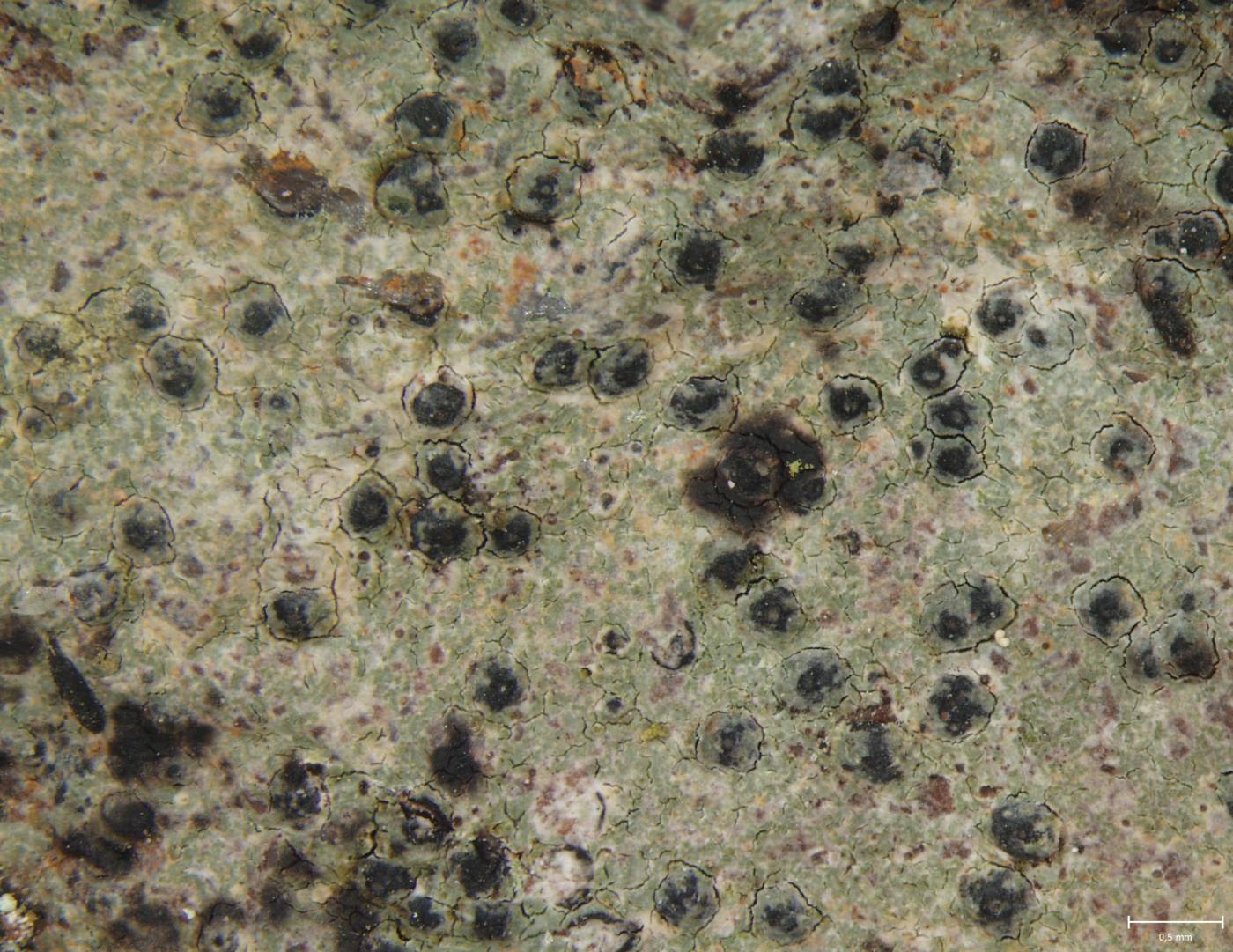
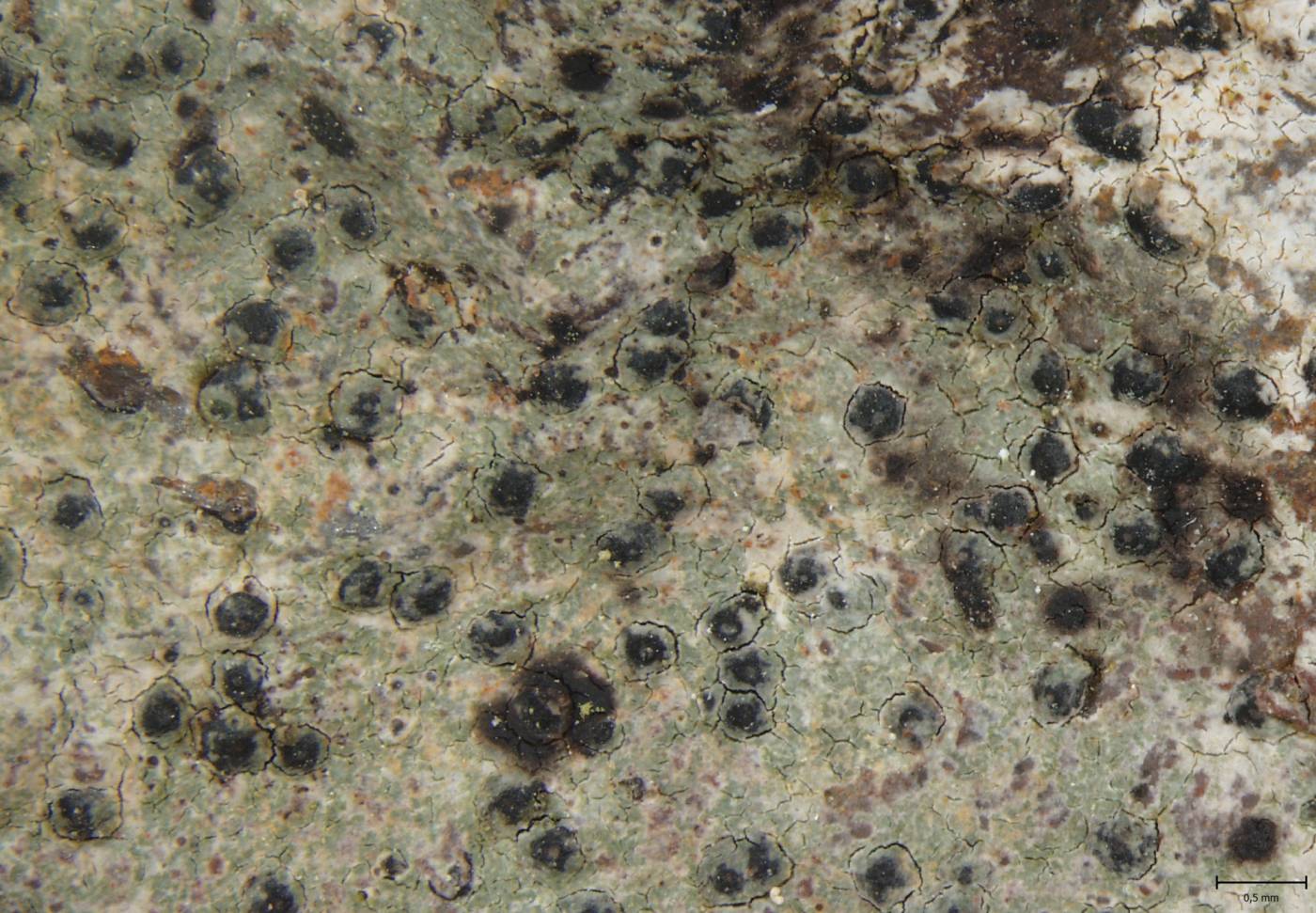
This species is characterized by a pale grey-green thallus and an often irregular apex of the involucrellum. Macroscopically, this appears as a ring of dark dots surrounded by a pale, opaque thallus and is often readily visible to the naked eye. Weakly developed forms may be confused with V. dolosa and V. hydrophila. Verrucaria elaeina differs from the similar V. praetermissa mainly in having a thinner thallus, less immersed perithecia, slightly smaller ascospores, and usually also by occurring in non-inundated habitats.
Verrucaria elaeina is particularly characteristic of weakly calcareous rocks in shade. It grows on limestone, concrete, siliceous rocks and brick, and even on terracotta pots. It is most often found in woodland, but may also occur on waste ground, in gardens, or on damp walls. The overall distribution of this taxon is still poorly known. Under its current name, it was first published from the Czech Republic only recently from Týřov in the Křivoklát region (Vondrák et al. 2022), and several further records from the western part of the country have been added since then. Four historical records were reported by Servít (1954) under the name V. guestphalica.
Literature: Orange A., Cannon P., Prieto M., Coppins B., Sanderson N. & Simkin J. (2023): Verrucariales: Verrucariaceae. – Revisions of British and Irish Lichens 31: 1–104. Vondrák J. et al. (2022): From Cinderella to Princess: an exceptional hotspot of lichen diversity in a long-inhabited central-European landscape. – Preslia 94: 143–181. Servít M. (1954): Československé lišejníky čeledi Verrucariaceae. – Nakladatelství ČSAV, Praha.
taxonomic classification:Ascomycota → Eurotiomycetes → Verrucariales → Verrucariaceae → Verrucaria
most frequented synonyms:Verrucaria guestphalicaRed List (Malíček 2023):DD – data deficient
Occurrence in the Czech Republic
All records: 14, confirmed 14. One click on a selected square displays particular record(s), including their source(s).