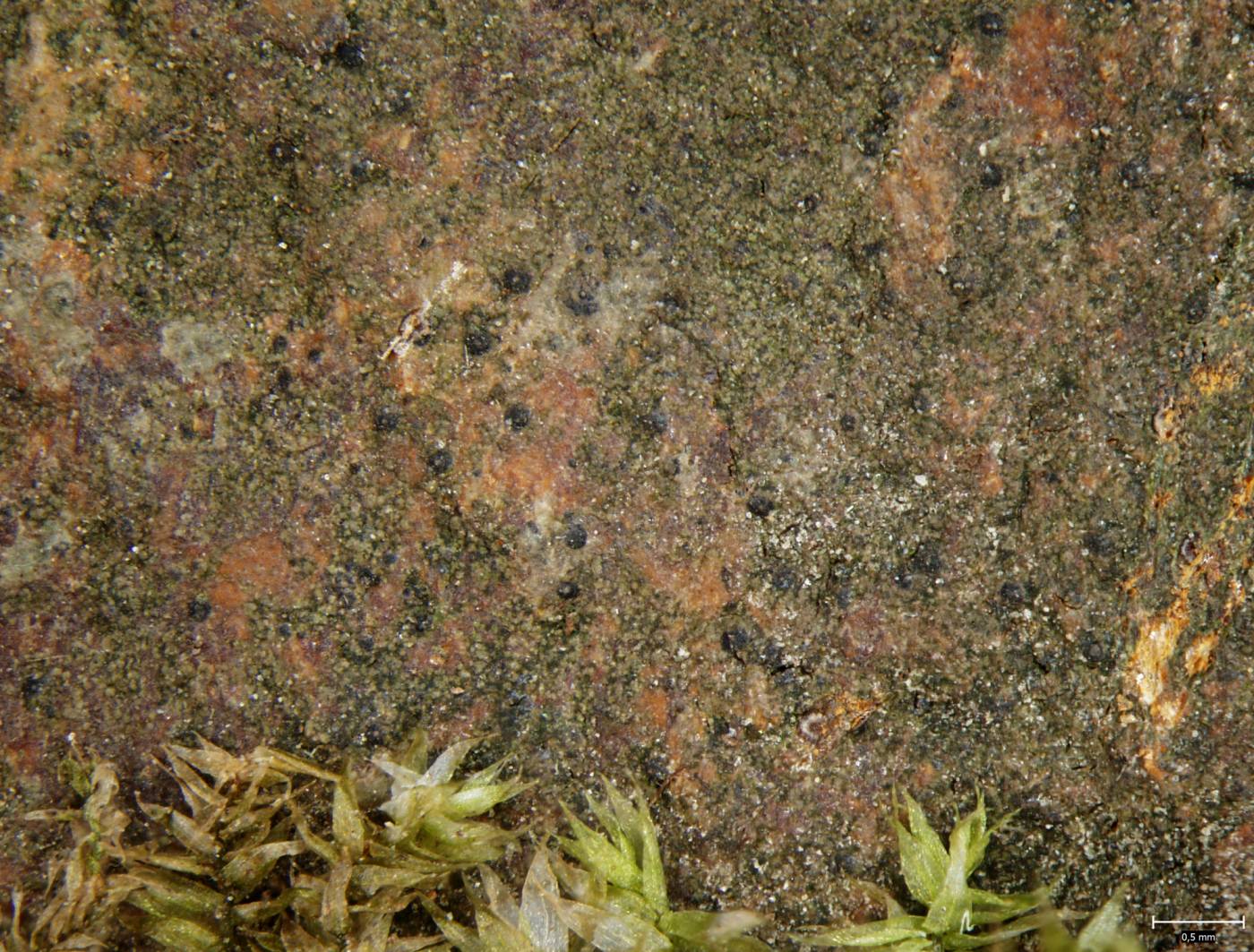
An inconspicuous Verrucaria with a predominantly brown thallus that is granular to continuous and often composed of goniocysts (25–50 µm). The perithecia are very small (0.11–0.19 mm), about 1/4 to 1/2 immersed, and typically extremely densely aggregated in this species. The involucrellum is usually thin and typically reaches down to the base of the excipulum. Ascospores are approximately 12.6–15.2 × 5.0–6.4 µm and may occasionally be 1-septate. It is best distinguished from similar species (e.g. V. hunsrueckensis, V. lapidicola, V. umbrinula) by the combination of small spores, a very high density of perithecia, and often the presence of goniocysts in the thallus.
It grows mainly on small stones lying on the ground, most often on siliceous substrates, less frequently on limestone or serpentinite; it may also occur on bricks and bark of tree bases. The species has been recorded from a range of habitats—forests, roadside margins, and disturbed sites (e.g. spoil heaps, quarries). It is frequent in partial shade to shade but also occurs in well-lit situations. Most sites are rather dry, yet it has also been found on periodically wetted stones along a stream.
Its overall distribution is still poorly known because the species was described only in 2024. In Finland (from where the type material originates) V. linkolae is considered common; additional records are known from Germany and Great Britain. In the Czech Republic it has been confirmed by several sequenced specimens from Týřov, Blanský les Hills, and the Drbákov–Albertovy skály.
Literature: Pykälä J., Kantelinen A. & Myllys L. (2024): Seven new species of Verrucaria from calcareous and siliceous rocks of Finland. – The Lichenologist 56: 259–272.
taxonomic classification:Ascomycota → Eurotiomycetes → Verrucariales → Verrucariaceae → Verrucaria
Occurrence in the Czech Republic
All records: 9, confirmed 9. One click on a selected square displays particular record(s), including their source(s).